
Hip Resurfacing
Hip resurfacing is a bone-preserving alternative to total hip replacement. Instead of removing the femoral head and replacing it with a stem, resurfacing caps the femoral head with a metal covering and places a metal cup in the acetabulum. This preserves bone stock for potential future revision and is designed for younger, active patients with good bone quality.

Understanding Your Procedure
In-Depth: Hip Resurfacing
A clear, comprehensive look at what this procedure is, how it works, and why it may be the right choice for you.
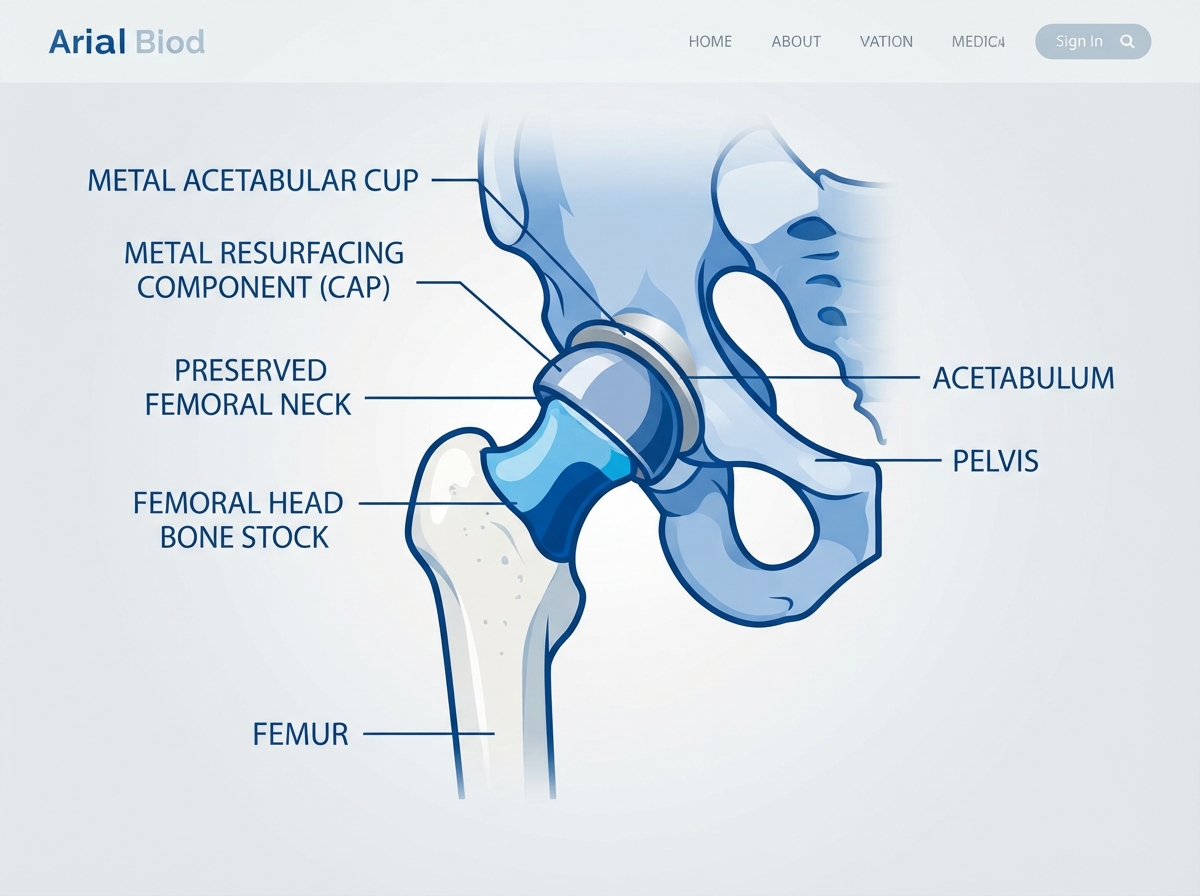
Hip Resurfacing — illustrated overview of the surgical approach and implant placement.
What Makes This Approach Different
Femoral Head Preservation
The and neck are preserved, not removed. This conserves bone stock for potential future revision, which is simpler than revising a stemmed total hip.
Metal-on-Metal Bearing
The resurfacing uses a metal cap on the and a metal cup in the , creating a hard-on-hard bearing surface that is very durable for active patients.
Designed for Active Patients
Resurfacing is specifically designed for younger, active patients who want to return to high-impact activities and may outlive a traditional .
Anatomical Femoral Loading
Because the femoral neck is preserved, forces are transferred through the bone in a natural pattern, potentially reducing stress shielding that can occur with stemmed implants.
Clinical information reviewed and edited by Dr. Ali H. Sobh, MD, board-certified orthopedic surgeon. Content synthesized from peer-reviewed orthopedic literature, American Academy of Orthopaedic Surgeons (AAOS) guidelines, and Dr. Sobh's fellowship training at Rush University Medical Center. Last updated 2025.
Watch & Learn
Understanding Hip Resurfacing
These medically accurate videos explain how hip resurfacing differs from total hip replacement — preserving the femoral neck and capping the bone rather than removing it, making it ideal for younger, active patients.
Birmingham Hip Resurfacing — Complete Guide
Dr. Jason Brockwell explains how hip arthritis is diagnosed, how Birmingham Hip Resurfacing (BHR) differs from total hip replacement, and why resurfacing preserves bone for younger patients. Covers the BHR implant design developed in the 1990s.
BHR Surgery — Inventor Derek McMinn
Watch Derek McMinn — inventor of the Birmingham Hip Resurfacing (BHR) — perform the procedure he pioneered. This surgical video shows the precise bone preparation and metal cap placement that defines hip resurfacing surgery.
Dr. Sobh's Hip Resurfacing Expertise
Videos embedded from YouTube for patient educational purposes. Dr. Dr. Ali H. Sobh, MD reviews all educational content on this page. Sources: Asia Medical Specialists (Dr. Jason Brockwell) and Derek McMinn (BHR Inventor).
Interactive Education
See How Your Joint Works
Understanding your condition is the first step toward confident decisions. Use this interactive visualizer to explore the anatomy of the hip joint, compare a healthy joint with an arthritic one, and see exactly what hip resurfacing restores.
- 1Toggle states to compare healthy, arthritic, and post-surgical joints.
- 2Tap the dots to learn about each anatomical structure.
- 3Watch the motion to see how the joint moves during activity.
Interactive Joint Visualizer
Explore how hip resurfacing works
Recognizing the Signs
Common Symptoms
Many patients live with joint pain for years before seeking treatment. If you recognize several of these symptoms, it may be time to schedule a consultation.
When to seek care
Why Dr. Sobh for This Procedure
Fellowship-Trained Expertise in Hip Resurfacing
Dr. Sobh's fellowship training included as part of his comprehensive adult reconstruction education. He carefully evaluates candidacy for resurfacing, which is appropriate for a narrow patient population—typically younger, active males with good bone quality and no significant deformity. He uses the Birmingham (BHR) system, the most studied and validated resurfacing with long-term registry data. His expertise in patient selection ensures that resurfacing is only recommended when it offers clear advantages over for the individual patient.
Conditions Treated
Is Hip Resurfacing Right for You?
Dr. Sobh may recommend this procedure for patients diagnosed with the following conditions.
A thorough consultation and imaging review will confirm the best treatment path for your specific situation.
Are You a Candidate?
Candidacy for Hip Resurfacing
Dr. Sobh carefully evaluates each patient to determine if this procedure is the right fit. Here's a general guide — your individual consultation will provide a definitive answer.
Younger, active patients (typically men under 60) with severe hip arthritis, good bone quality, and normal femoral head anatomy confirmed on X-rays.
Patients who want to preserve bone stock for potential future revision and return to high-impact activities.
Women of childbearing age are generally not candidates due to unknown effects of metal ions on fetal development. Patients with poor bone quality, small femoral heads, or significant femoral head deformity (e.g., from advanced AVN) are not candidates.
Patients with metal sensitivity, kidney disease (which affects metal ion clearance), or inflammatory arthritis are typically not candidates for metal-on-metal resurfacing.
Technology & Techniques
Advanced Technology Used in Your Surgery
Dr. Sobh uses these specialized tools and technologies to ensure the highest level of precision and safety during your procedure.
Birmingham Hip Resurfacing (BHR)
The most studied and validated hip resurfacing system, with long-term registry data supporting its use in appropriately selected patients.
Metal-on-Metal Bearing
Cobalt-chromium cap and cup create a durable hard-on-hard bearing surface designed for active patients.
Cementless Fixation
Both the resurfacing cap and acetabular cup achieve biological fixation through bone ingrowth, eliminating the need for cement.
How the Surgery Works
Understanding Your Surgical Journey
From your first consultation to full recovery, here's what to expect at each stage. Dr. Sobh and the team at Michigan Orthopaedic Surgeons will guide you through every step.
Candidacy Evaluation
Dr. Sobh carefully evaluates bone quality, anatomy, and patient factors to determine if resurfacing is appropriate. This is only recommended for a narrow patient population.
Femoral Head Resurfacing
The is trimmed and capped with a metal resurfacing component, preserving the femoral neck and bone stock. A metal cup is placed in the .
Metal-on-Metal Bearing
The metal cap and metal cup create a durable bearing surface designed for active patients who want to return to high-impact activities.
Recovery & Activity Return
Recovery is similar to . Once healed, patients can return to high-impact activities that are typically discouraged after .
Recovery Timeline
Your Path Back to Activity
Recovery timelines vary by individual and procedure complexity. Dr. Sobh will provide a personalized rehabilitation plan. Here's a general guide to what most patients experience.
Day of Surgery
Stand and walk with assistance. Pain managed with multimodal protocol. Most patients go home within 24-48 hours.
Early Recovery
Walk with a walker or cane. Physical therapy focuses on gait and hip stability. Incision heals.
Progressive Activity
Transition off walking aids. Resume driving and office work. Therapy advances to strengthening.
Full Recovery
Return to sports, including high-impact activities. Bone preservation allows future revision if needed.
Comparing Your Options
Hip Resurfacing vs. Alternatives
Understanding how hip resurfacing compares to other treatment options helps you make an informed decision. Dr. Sobh will discuss all viable options during your consultation.
Total Hip Replacement
Total hip removes the and replaces it with a stem. Resurfacing caps the , preserving bone. Total hip is appropriate for all patient types; resurfacing is only for a narrow population (young, active males with good bone).
Direct Anterior Hip Replacement
The anterior approach is a surgical approach to . Resurfacing is a different procedure entirely that preserves the . The two are not interchangeable—resurfacing is chosen for bone preservation, the anterior approach for muscle preservation.
Hip Arthroscopy
Arthroscopy addresses labral tears, impingement, or loose bodies but cannot reverse arthritis. Resurfacing is a definitive treatment for severe arthritis that replaces the joint surfaces.
Patient Journey Tip
Benefits
This procedure offers significant advantages for qualified patients:
- Preserves femoral head and bone stock
- Easier revision to total hip if needed
- Designed for younger, active patients
- Allows return to high-impact activities
- Anatomical femoral loading
- Durable metal-on-metal bearing
Potential Risks
As with any surgery, there are potential risks. Dr. Sobh takes extensive measures to minimize them:
- Femoral neck fracture (unique to resurfacing, ~1-2%)
- Metal ion concerns (cobalt/chromium levels)
- Not suitable for women of childbearing age
- Narrow candidacy criteria
- Implant loosening over time
- Anesthesia-related risks
Important
Patient Questions
Frequently Asked Questions
Common questions patients ask about hip resurfacing.
Am I a candidate for hip resurfacing?
Am I a candidate for hip resurfacing?
is appropriate for a narrow patient population: typically younger, active males under 60 with good bone quality and normal anatomy. Dr. Sobh will evaluate your X-rays, bone quality, and activity goals to determine if resurfacing is right for you.
Why isn't hip resurfacing recommended for everyone?
Why isn't hip resurfacing recommended for everyone?
Resurfacing carries unique risks (femoral neck fracture, metal ion concerns) and requires good bone quality and specific anatomy. It is not suitable for women of childbearing age, patients with poor bone quality, or those with inflammatory arthritis. is appropriate for a much broader patient population.
Can I return to running and high-impact sports after resurfacing?
Can I return to running and high-impact sports after resurfacing?
Yes. One of the advantages of resurfacing is that it is designed for active patients who want to return to high-impact activities. However, you should wait until full healing (typically 3-6 months) and discuss specific activity goals with Dr. Sobh.
What happens if the resurfacing wears out?
What happens if the resurfacing wears out?
If resurfacing ever needs revision, the conversion to is typically simpler than revising a stemmed total hip, because the femoral canal has never been reamed. This bone preservation is one of the key advantages of resurfacing for younger patients.
This procedure page was clinically reviewed and approved by Dr. Ali H. Sobh, MD, a board-certified, fellowship-trained orthopedic surgeon specializing in direct anterior hip replacement and MAKO robotic knee surgery. Dr. Sobh graduated with high honors from Wayne State University School of Medicine and completed his adult reconstruction fellowship at Rush University Medical Center in Chicago. He practices at Michigan Orthopaedic Surgeons (MOS) with offices in Royal Oak and Southfield, Michigan.
This information is for educational purposes only and is not a substitute for professional medical advice. Individual results and recovery timelines vary. Schedule a consultation with Dr. Sobh to discuss your specific condition and treatment options.

Ready to Take the Next Step?
Schedule a personalized consultation with Dr. Sobh to discuss whether hip resurfacing is right for you. Our team will help coordinate your visit, insurance verification, and pre-operative planning.
Explore More
Related Procedures
Direct Anterior Hip Replacement
Minimally invasive muscle-sparing hip replacement with no muscle cutting for faster recovery.
Revision Hip Replacement
Complex reconstructive surgery to correct failed, worn, or infected prior hip replacements.
Total Hip Replacement
Complete hip joint reconstruction replacing both the femoral head and acetabulum with durable biocompatible implants.
Helpful Patient Resources