
Direct Anterior Hip Replacement
Anterior hip replacement is a minimally invasive hip surgery performed to replace the hip joint without cutting through any muscles. It is also referred to as muscle-sparing surgery because no muscles are detached, enabling patients to experience less post-operative pain and a significantly quicker return to active daily living.

Understanding Your Procedure
In-Depth: Direct Anterior Hip Replacement
A clear, comprehensive look at what this procedure is, how it works, and why it may be the right choice for you.
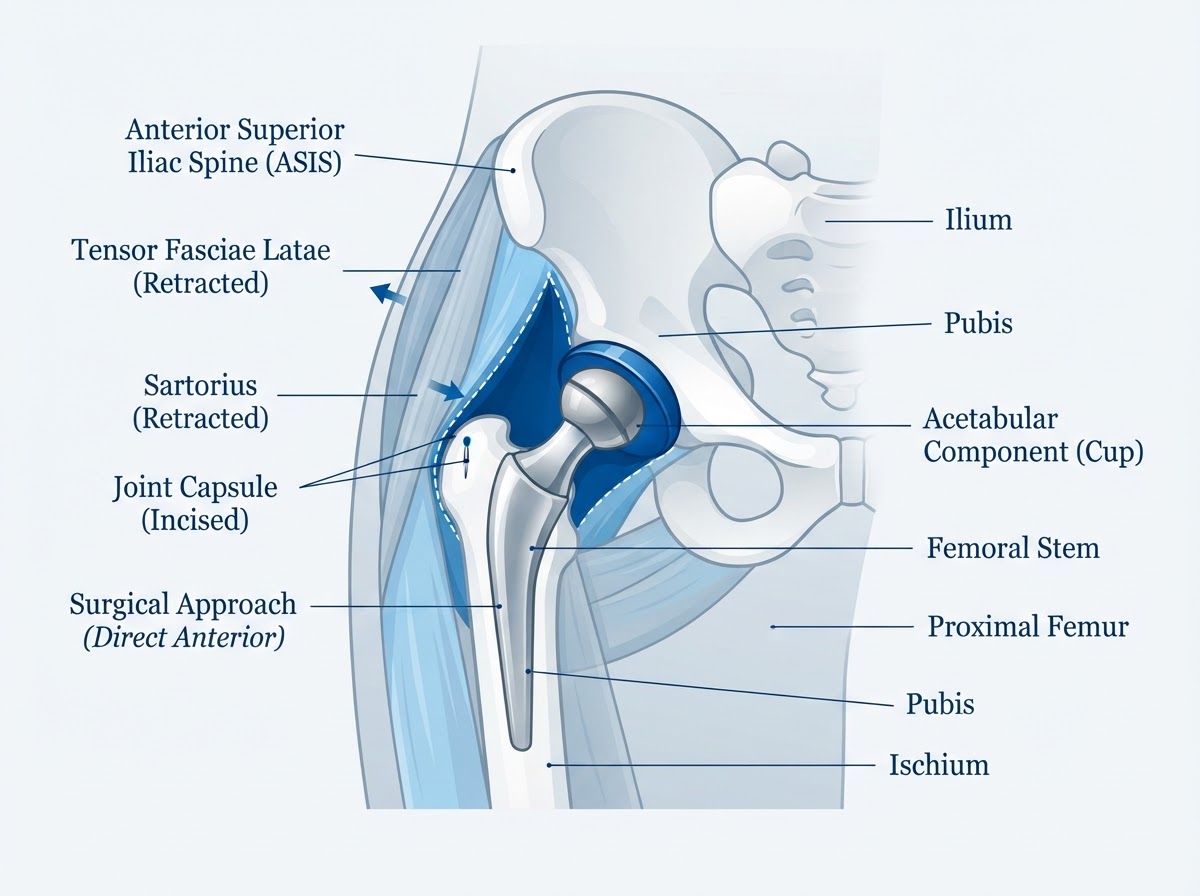
Direct Anterior Hip Replacement — illustrated overview of the surgical approach and implant placement.
What Makes This Approach Different
True Muscle-Sparing Approach
No muscles or tendons are cut or detached. Dr. Sobh works between the sartorius and tensor fasciae latae muscles, preserving the hip's natural stabilizers.
No Hip Precautions
Unlike posterior approaches, there are no restrictions on bending, crossing legs, or sitting positions after surgery. Patients move naturally from day one.
Specialized Hana Table
The procedure uses a specialized orthopedic table that allows intra-operative () to confirm positioning in real time, ensuring precise placement.
Lower Dislocation Rate
Because the posterior capsule is never violated, the risk of is significantly lower than with posterior approaches—typically under 0.5%.
Clinical information reviewed and edited by Dr. Ali H. Sobh, MD, board-certified orthopedic surgeon. Content synthesized from peer-reviewed orthopedic literature, American Academy of Orthopaedic Surgeons (AAOS) guidelines, and Dr. Sobh's fellowship training at Rush University Medical Center. Last updated 2025.
Watch & Learn
Understanding Direct Anterior Hip Replacement
These medically accurate videos show how the direct anterior approach works — accessing the hip joint through a natural muscle interval for faster recovery and fewer movement restrictions.
Direct Anterior Approach Hip Replacement
Dr. Ajoy Jana of Nebraska Methodist Health System explains the direct anterior approach, working between muscles rather than cutting through them. This technique, used since 2007, results in less tissue damage and faster recovery.
Anterior Approach Anatomy Animation
Dr. Cory Calendine presents a 3D animation demonstrating how the direct anterior approach accesses the hip joint through a natural interval between muscles, resulting in less postoperative pain and fewer movement restrictions.
Dr. Sobh's Direct Anterior Expertise
Videos embedded from YouTube for patient educational purposes. Dr. Dr. Ali H. Sobh, MD reviews all educational content on this page. Sources: Nebraska Methodist Health System (Dr. Ajoy Jana) and Bone Doctor (Dr. Cory Calendine, MD).
Interactive Education
See How Your Joint Works
Understanding your condition is the first step toward confident decisions. Use this interactive visualizer to explore the anatomy of the hip joint, compare a healthy joint with an arthritic one, and see exactly what direct anterior hip replacement restores.
- 1Toggle states to compare healthy, arthritic, and post-surgical joints.
- 2Tap the dots to learn about each anatomical structure.
- 3Watch the motion to see how the joint moves during activity.
Interactive Joint Visualizer
Explore how direct anterior hip replacement works
Recognizing the Signs
Common Symptoms
Many patients live with joint pain for years before seeking treatment. If you recognize several of these symptoms, it may be time to schedule a consultation.
When to seek care
Why Dr. Sobh for This Procedure
Fellowship-Trained Expertise in Direct Anterior Hip Replacement
Dr. Sobh completed a prestigious fellowship at Rush University Medical Center in Chicago, where he trained exclusively in the direct anterior muscle-sparing hip approach. Unlike traditional surgery that cuts through muscle, Dr. Sobh accesses the hip joint between muscles—allowing same-day walking, no , and a dramatically faster return to daily life. His fellowship focused on advanced positioning techniques that maximize longevity and stability, reducing risk.
Conditions Treated
Is Direct Anterior Hip Replacement Right for You?
Dr. Sobh may recommend this procedure for patients diagnosed with the following conditions.
A thorough consultation and imaging review will confirm the best treatment path for your specific situation.
Are You a Candidate?
Candidacy for Direct Anterior Hip Replacement
Dr. Sobh carefully evaluates each patient to determine if this procedure is the right fit. Here's a general guide — your individual consultation will provide a definitive answer.
Patients with severe hip osteoarthritis, AVN, or post-traumatic arthritis whose pain has not responded to conservative treatments (NSAIDs, physical therapy, injections) for at least 3-6 months.
Patients of nearly any BMI and activity level. The anterior approach is particularly beneficial for active patients who want the fastest possible return to work and recreation.
Patients with prior hip surgery through a posterior approach may require the same approach for revision. Very muscular or obese patients may present technical challenges, though Dr. Sobh evaluates each case individually.
Patients with active hip infection or severe vascular disease need to resolve those conditions before any elective joint replacement.
Technology & Techniques
Advanced Technology Used in Your Surgery
Dr. Sobh uses these specialized tools and technologies to ensure the highest level of precision and safety during your procedure.
Hana Orthopedic Table
A specialized table that hyperextends the operative leg and provides carbon-fiber imaging for real-time fluoroscopic confirmation of implant size and position.
Fluoroscopic Imaging
Intra-operative X-ray allows Dr. Sobh to verify leg length, offset, and cup position during surgery—something not possible with traditional approaches.
Premium Bearing Surfaces
Dr. Sobh offers ceramic-on-polyethylene and ceramic-on-ceramic bearings, selected based on your age, activity level, and anatomy to maximize implant longevity.
How the Surgery Works
Understanding Your Surgical Journey
From your first consultation to full recovery, here's what to expect at each stage. Dr. Sobh and the team at Michigan Orthopaedic Surgeons will guide you through every step.
Pre-Operative Planning
Advanced imaging is used to plan size and alignment specific to your anatomy. You will receive personalized pre-operative instructions and optimization guidance.
Minimally Invasive Surgery
Through a small front-facing (anterior) incision, Dr. Sobh accesses the hip joint between muscles—without detaching or cutting any muscle tissue. The damaged ball and socket are replaced with biocompatible implants.
Same-Day Mobilization
Because no muscles are cut, patients are encouraged to stand and walk with assistance on the day of surgery, dramatically reducing stiffness and blood clot risk.
Rapid Rehabilitation
A structured, accelerated program begins immediately. Most patients return home within 24 hours and resume light daily activities within 1-2 weeks.
Recovery Timeline
Your Path Back to Activity
Recovery timelines vary by individual and procedure complexity. Dr. Sobh will provide a personalized rehabilitation plan. Here's a general guide to what most patients experience.
Day of Surgery
Stand and walk with assistance. Begin gentle hip movements. Most patients are discharged home the same day or next morning.
Early Recovery
Walk with a walker or cane. Return to light household activities. Physical therapy focuses on gait training and hip stability.
Progressive Activity
Transition off walking aids. Resume driving (if right hip). Return to office work. Therapy advances to strengthening and balance.
Full Recovery
Return to low-impact sports, golf, swimming, and cycling. Tissue remodeling continues. Most patients report near-complete pain relief.
Comparing Your Options
Direct Anterior Hip Replacement vs. Alternatives
Understanding how direct anterior hip replacement compares to other treatment options helps you make an informed decision. Dr. Sobh will discuss all viable options during your consultation.
Posterior Hip Replacement
The posterior approach cuts through the gluteus maximus and to access the hip from behind. It requires for 6-12 weeks and has a higher risk (~2-3%). The anterior approach avoids cutting these muscles entirely.
Anterolateral (Hardinge) Approach
The anterolateral approach splits the gluteus medius and minimus. While it has a lower rate than posterior, it still damages the hip abductors, which can cause a persistent limp. The preserves these abductors completely.
Hip Resurfacing
Resurfacing preserves the but is only suitable for a narrow patient population (typically younger, active males with good bone quality). It carries unique risks (femoral neck fracture, metal ion concerns) and is not appropriate for most patients.
Patient Journey Tip
Benefits
This procedure offers significant advantages for qualified patients:
- No muscle cutting or detachment
- Less post-operative pain
- Faster return to walking and daily activities
- Lower risk of hip dislocation
- No hip precautions after surgery
- Smaller incision and less scarring
- Immediate weight bearing
Potential Risks
As with any surgery, there are potential risks. Dr. Sobh takes extensive measures to minimize them:
- Infection (rare, <1%)
- Blood clots (DVT/PE)—prevented with medication and early walking
- Leg length discrepancy
- Implant loosening over time
- Fracture during or after surgery
- Anesthesia-related risks
Important
Patient Questions
Frequently Asked Questions
Common questions patients ask about direct anterior hip replacement.
Why is the anterior approach better than traditional hip replacement?
Why is the anterior approach better than traditional hip replacement?
The accesses the hip between muscles rather than cutting through them. This means less pain, faster recovery, lower risk, and no need for (such as avoiding certain sitting positions) that traditional approaches require.
Will I really walk the same day?
Will I really walk the same day?
Yes. Because no muscles are detached, most patients stand and take steps with a physical therapist on the day of surgery. This early mobility is key to a rapid recovery and reduces complications.
How long do anterior hip implants last?
How long do anterior hip implants last?
Modern hip implants typically last 20-30 years or more. Dr. Sobh uses premium bearing surfaces and precise alignment techniques to maximize the longevity of your .
Is this approach covered by insurance?
Is this approach covered by insurance?
Yes. Direct anterior hip replacement is a standard, widely covered procedure. Our office will verify your insurance benefits and discuss any out-of-pocket costs before surgery.
This procedure page was clinically reviewed and approved by Dr. Ali H. Sobh, MD, a board-certified, fellowship-trained orthopedic surgeon specializing in direct anterior hip replacement and MAKO robotic knee surgery. Dr. Sobh graduated with high honors from Wayne State University School of Medicine and completed his adult reconstruction fellowship at Rush University Medical Center in Chicago. He practices at Michigan Orthopaedic Surgeons (MOS) with offices in Royal Oak and Southfield, Michigan.
This information is for educational purposes only and is not a substitute for professional medical advice. Individual results and recovery timelines vary. Schedule a consultation with Dr. Sobh to discuss your specific condition and treatment options.

Ready to Take the Next Step?
Schedule a personalized consultation with Dr. Sobh to discuss whether direct anterior hip replacement is right for you. Our team will help coordinate your visit, insurance verification, and pre-operative planning.
Explore More
Related Procedures
Revision Hip Replacement
Complex reconstructive surgery to correct failed, worn, or infected prior hip replacements.
Total Hip Replacement
Complete hip joint reconstruction replacing both the femoral head and acetabulum with durable biocompatible implants.
Minimally Invasive Total Hip Replacement
Total hip replacement through smaller incisions with reduced tissue trauma for faster recovery.
Helpful Patient Resources