
Revision Hip Replacement
Revision hip replacement involves removing a previously installed hip implant that has worn out, loosened, or developed complications, replacing it with specialized reconstructive components to rebuild stability and alleviate pain.

Understanding Your Procedure
In-Depth: Revision Hip Replacement
A clear, comprehensive look at what this procedure is, how it works, and why it may be the right choice for you.
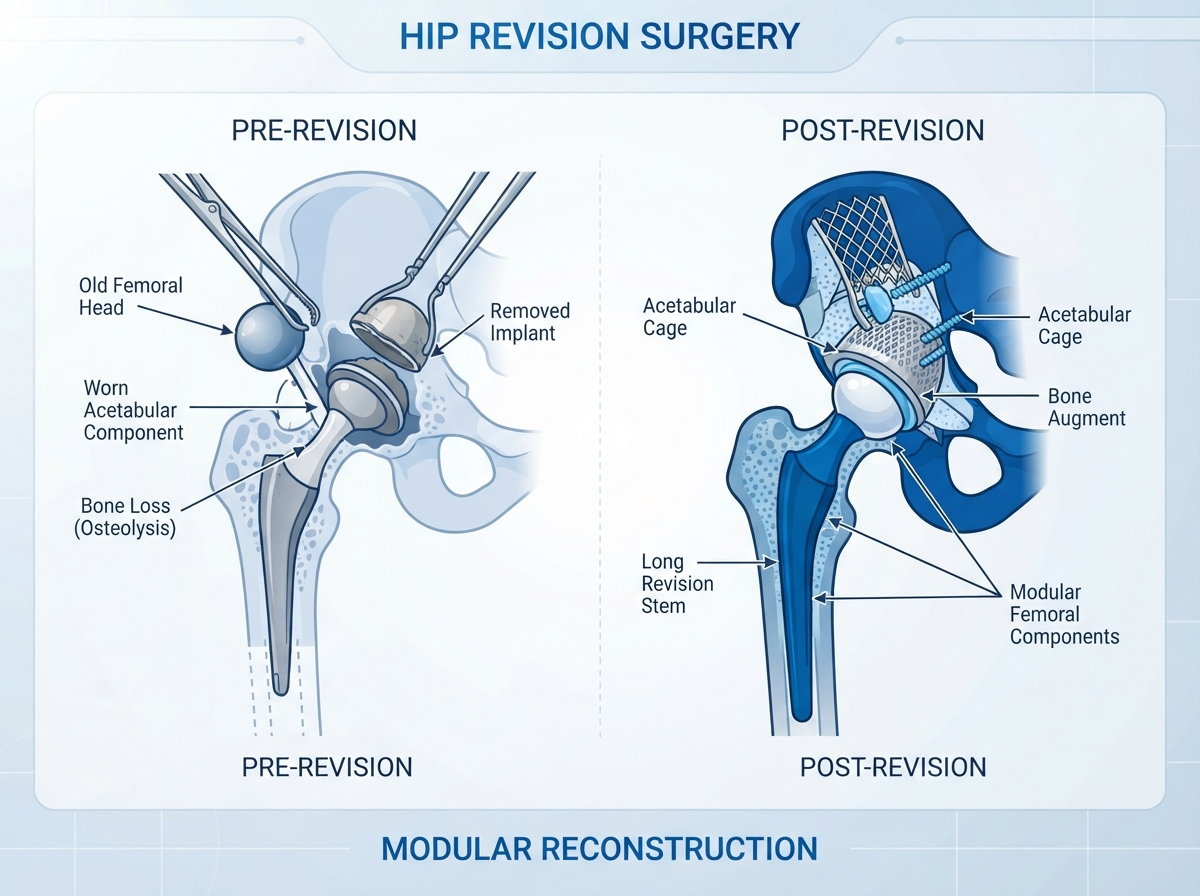
Revision Hip Replacement — illustrated overview of the surgical approach and implant placement.
What Makes This Approach Different
Modular Revision Implants
Revision hips use modular components that can be assembled intra-operatively to address specific patterns of bone loss and instability, something primary implants cannot do.
Bone Grafting & Augmentation
Lost bone is rebuilt using allograft bone, metal augments, or reinforcing cages (cage reconstruction) to create a stable foundation for the new .
Infection Management Protocol
Infected hips require a specialized two-stage protocol: removing the , placing an antibiotic spacer, and re-implanting after the infection is cleared.
Custom Reconstruction Planning
Each revision is unique. Dr. Sobh uses advanced CT imaging and 3D planning to map the bone loss and plan the exact reconstructive strategy before surgery.
Clinical information reviewed and edited by Dr. Ali H. Sobh, MD, board-certified orthopedic surgeon. Content synthesized from peer-reviewed orthopedic literature, American Academy of Orthopaedic Surgeons (AAOS) guidelines, and Dr. Sobh's fellowship training at Rush University Medical Center. Last updated 2025.
Watch & Learn
Understanding Revision Hip Replacement
These medically accurate videos explain why hip replacements may fail over time and how revision surgery removes worn or loose components, manages bone loss, and restores joint stability with specialized revision implants.
Hip Replacement & Revision — Animation
The Scopic Vision's 3D animation covers hip replacement surgery, including how revision procedures replace worn or failed prosthetic components. Explains the types of hip replacement, minimally invasive and robotic techniques, and when revision becomes necessary.
Revision Hip Arthroplasty — Comprehensive Guide
Dr. Jibanananda Satpathy of VCU Health System presents a detailed lecture on complex revision hip arthroplasty — covering the causes of implant failure, bone loss classification, acetabular reconstruction techniques, and the decision-making process for revision surgery.
Dr. Sobh's Revision Hip Expertise
Videos embedded from YouTube for patient educational purposes. Dr. Dr. Ali H. Sobh, MD reviews all educational content on this page. Sources: The Scopic Vision and Orthopaedic Principles (Dr. Jibanananda Satpathy, VCU Health).
Interactive Education
See How Your Joint Works
Understanding your condition is the first step toward confident decisions. Use this interactive visualizer to explore the anatomy of the hip joint, compare a healthy joint with an arthritic one, and see exactly what revision hip replacement restores.
- 1Toggle states to compare healthy, arthritic, and post-surgical joints.
- 2Tap the dots to learn about each anatomical structure.
- 3Watch the motion to see how the joint moves during activity.
Interactive Joint Visualizer
Explore how revision hip replacement works
Recognizing the Signs
Common Symptoms
Many patients live with joint pain for years before seeking treatment. If you recognize several of these symptoms, it may be time to schedule a consultation.
When to seek care
Why Dr. Sobh for This Procedure
Fellowship-Trained Expertise in Revision Hip Replacement
is one of the most demanding procedures in orthopedics. Dr. Sobh's fellowship at Rush University specifically included complex revision training—removing failed implants, restoring lost bone with grafts, and rebuilding hip stability with specialized modular revision components. He is widely recognized for correcting problems from hip replacements performed elsewhere, and has earned the trust of referring physicians across metro Detroit for his expertise in managing infected, loose, and unstable hip replacements.
Conditions Treated
Is Revision Hip Replacement Right for You?
Dr. Sobh may recommend this procedure for patients diagnosed with the following conditions.
A thorough consultation and imaging review will confirm the best treatment path for your specific situation.
Are You a Candidate?
Candidacy for Revision Hip Replacement
Dr. Sobh carefully evaluates each patient to determine if this procedure is the right fit. Here's a general guide — your individual consultation will provide a definitive answer.
Patients with a painful hip replacement from aseptic loosening, wear, osteolysis, recurrent dislocation, or periprosthetic fracture. Diagnostic workup includes X-rays, CT scan, blood tests, and often joint aspiration.
Patients with an infected hip replacement (PJI) requiring a two-stage revision protocol, working in coordination with infectious disease specialists.
Patients with a well-functioning, painless hip replacement do not need revision. 'Preventive' revision is not recommended—the risks of surgery outweigh any benefit.
Patients with severe medical comorbidities that cannot be optimized may not be safe candidates for revision surgery, which is longer and more physiologically demanding than primary replacement.
Technology & Techniques
Advanced Technology Used in Your Surgery
Dr. Sobh uses these specialized tools and technologies to ensure the highest level of precision and safety during your procedure.
Modular Revision Stems
Specialized femoral stems with modular bodies and heads that can be assembled to address varying degrees of bone loss and leg length discrepancy.
Acetabular Revision Cups & Cages
When the hip socket has significant bone loss, Dr. Sobh uses revision cups with augmenting screws, jumbo cups, or reinforcing cages (anti-protrusio cages) to rebuild the socket.
Bone Grafting (Morselized & Structural)
Donor bone is used to rebuild lost bone stock—either as small fragments packed into defects (morselized) or as larger structural grafts for major defects.
Antibiotic-Loaded Spacers
For infected hips, an antibiotic-loaded cement spacer is placed temporarily to maintain hip space and deliver high-dose local antibiotics while the infection clears.
How the Surgery Works
Understanding Your Surgical Journey
From your first consultation to full recovery, here's what to expect at each stage. Dr. Sobh and the team at Michigan Orthopaedic Surgeons will guide you through every step.
Custom Surgical Planning
Because every revision is unique, Dr. Sobh plans a personalized reconstructive strategy. This may include specialized modular revision implants, bone grafts, or reinforcing rings to rebuild lost bone stock.
Implant Removal & Reconstruction
The old is carefully removed. Damaged bone is restored with grafts or augments. New revision components are implanted to rebuild hip stability and leg length.
Infection Management
If infection is present, a staged approach may be used: first removing the and placing an antibiotic spacer, then re-implanting a new hip after the infection is cleared.
Structured Rehabilitation
Recovery from revision surgery is more gradual than primary replacement. A tailored program protects the reconstruction while restoring strength and mobility.
Recovery Timeline
Your Path Back to Activity
Recovery timelines vary by individual and procedure complexity. Dr. Sobh will provide a personalized rehabilitation plan. Here's a general guide to what most patients experience.
Hospital Stay
Longer than primary surgery due to complexity. Begin protected walking with a walker. Pain managed with multimodal protocol.
Early Recovery
Continue protected weight bearing as directed. Physical therapy focuses on safe mobility and hip stability.
Strengthening Phase
Gradually increase activity. Therapy advances based on the extent of reconstruction. Most patients transition off walking aids.
Full Recovery
Return to daily activities. Complete bone and soft tissue healing. Ongoing monitoring ensures implant stability.
Comparing Your Options
Revision Hip Replacement vs. Alternatives
Understanding how revision hip replacement compares to other treatment options helps you make an informed decision. Dr. Sobh will discuss all viable options during your consultation.
Primary Hip Replacement
Primary replacement places implants into native bone for the first time. Revision removes the old , rebuilds lost bone, and places specialized components—a much longer and more complex operation.
Girdlestone (Resection Arthroplasty)
In severe infections where re-implantation is not possible, the hip is removed and not replaced, leaving a shortened, unstable leg. This is a last-resort option when revision is not feasible.
Chronic Suppression (Antibiotics Only)
For patients too frail for revision surgery, long-term oral antibiotics may suppress a low-grade infection. This does not cure the infection and is not appropriate for active patients.
Patient Journey Tip
Benefits
This procedure offers significant advantages for qualified patients:
- Relieves pain from a failed hip replacement
- Restores hip stability and eliminates dislocation
- Rebuilds lost bone with grafts and augments
- Corrects leg length discrepancy
- Improves walking ability and quality of life
- Addresses infection with specialized protocols
Potential Risks
As with any surgery, there are potential risks. Dr. Sobh takes extensive measures to minimize them:
- Higher complication rate than primary replacement
- Bone loss requiring grafting
- Infection (higher risk in revision)
- Dislocation or instability
- Nerve or blood vessel injury
- Need for future revision
- Anesthesia-related risks
Important
Patient Questions
Frequently Asked Questions
Common questions patients ask about revision hip replacement.
Why do hip replacements need revision?
Why do hip replacements need revision?
Hip implants can fail due to wear over decades, from bone loss (osteolysis), recurrent , infection, or fracture. Dr. Sobh will identify the specific cause and plan the appropriate reconstruction.
Is revision hip surgery more complicated than the original surgery?
Is revision hip surgery more complicated than the original surgery?
Yes. Revision requires removing the old , addressing bone loss, and rebuilding the joint with specialized components. Dr. Sobh's fellowship training at Rush University specifically included complex revision .
How long is recovery from revision hip surgery?
How long is recovery from revision hip surgery?
Recovery is longer than primary hip replacement—typically 3-6 months—because the reconstruction is more complex. Dr. Sobh will give you a personalized recovery plan based on the extent of your surgery.
What if my hip replacement is infected?
What if my hip replacement is infected?
Infected hip replacements are treated with a two-stage protocol: first removing the and placing an antibiotic spacer, then after the infection is cleared, implanting a new hip. Dr. Sobh works with infectious disease specialists for optimal outcomes.
This procedure page was clinically reviewed and approved by Dr. Ali H. Sobh, MD, a board-certified, fellowship-trained orthopedic surgeon specializing in direct anterior hip replacement and MAKO robotic knee surgery. Dr. Sobh graduated with high honors from Wayne State University School of Medicine and completed his adult reconstruction fellowship at Rush University Medical Center in Chicago. He practices at Michigan Orthopaedic Surgeons (MOS) with offices in Royal Oak and Southfield, Michigan.
This information is for educational purposes only and is not a substitute for professional medical advice. Individual results and recovery timelines vary. Schedule a consultation with Dr. Sobh to discuss your specific condition and treatment options.

Ready to Take the Next Step?
Schedule a personalized consultation with Dr. Sobh to discuss whether revision hip replacement is right for you. Our team will help coordinate your visit, insurance verification, and pre-operative planning.
Explore More
Related Procedures
Direct Anterior Hip Replacement
Minimally invasive muscle-sparing hip replacement with no muscle cutting for faster recovery.
Total Hip Replacement
Complete hip joint reconstruction replacing both the femoral head and acetabulum with durable biocompatible implants.
Minimally Invasive Total Hip Replacement
Total hip replacement through smaller incisions with reduced tissue trauma for faster recovery.
Helpful Patient Resources