
Minimally Invasive Total Hip Replacement
Minimally invasive total hip replacement uses smaller incisions and muscle-sparing techniques to perform complete hip joint replacement with less tissue trauma. This approach reduces post-operative pain, blood loss, and hospital stay while achieving the same durable result as traditional surgery.

Understanding Your Procedure
In-Depth: Minimally Invasive Total Hip Replacement
A clear, comprehensive look at what this procedure is, how it works, and why it may be the right choice for you.
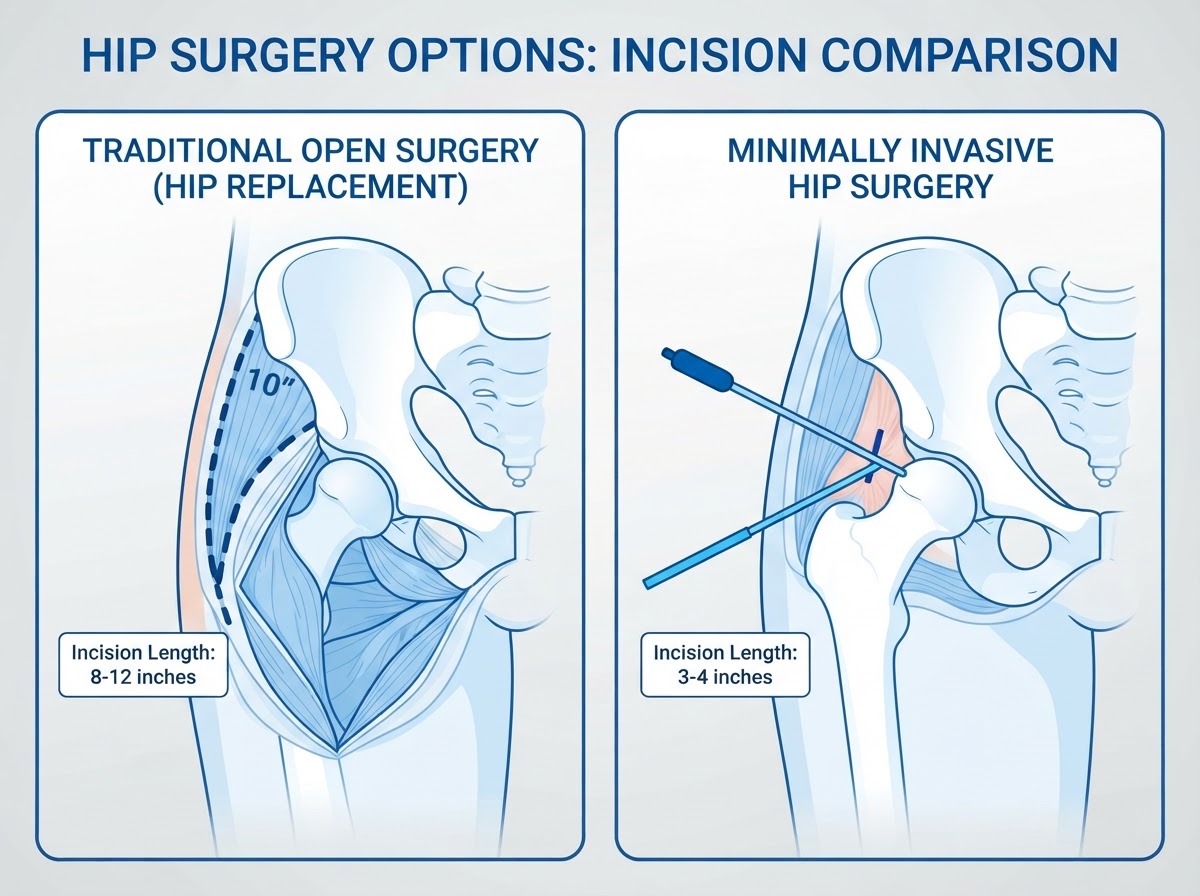
Minimally Invasive Total Hip Replacement — illustrated overview of the surgical approach and implant placement.
What Makes This Approach Different
Smaller Incision
Incisions of 3-5 inches rather than 8-12 inches, resulting in less tissue trauma, smaller scar, and reduced blood loss.
Muscle-Sparing Technique
Specialized instruments allow Dr. Sobh to work between muscles rather than cutting through them, preserving the hip's natural stabilizers.
Reduced Blood Loss
Minimally invasive techniques typically result in significantly less blood loss, reducing the need for transfusion.
Faster Recovery
Less tissue trauma translates to less pain, shorter hospital stay (often same-day discharge), and faster return to walking and daily activities.
Clinical information reviewed and edited by Dr. Ali H. Sobh, MD, board-certified orthopedic surgeon. Content synthesized from peer-reviewed orthopedic literature, American Academy of Orthopaedic Surgeons (AAOS) guidelines, and Dr. Sobh's fellowship training at Rush University Medical Center. Last updated 2025.
Watch & Learn
Understanding Minimally Invasive Hip Replacement
These medically accurate videos demonstrate how minimally invasive hip replacement uses smaller incisions and specialized techniques to reduce tissue damage, blood loss, and recovery time.
Minimally Invasive Direct Anterior THR
Nucleus Medical Media's 3D animation depicts a minimally invasive direct anterior total hip replacement of the right hip, including an overview of hip anatomy, pathology, surgical risks, and benefits — with use of a specialized table and fluoroscopy.
Outpatient Total Hip Replacement — Live Surgery
Dr. Scott Goldsmith walks through an outpatient total hip replacement for a 68-year-old female, demonstrating the minimally invasive approach, spinal anesthesia protocol, and same-day ambulation that defines modern minimally invasive hip surgery.
Dr. Sobh's Minimally Invasive Expertise
Videos embedded from YouTube for patient educational purposes. Dr. Dr. Ali H. Sobh, MD reviews all educational content on this page. Sources: Nucleus Medical Media and Orthopaedic Medical Group of Tampa Bay (Dr. Scott Goldsmith).
Interactive Education
See How Your Joint Works
Understanding your condition is the first step toward confident decisions. Use this interactive visualizer to explore the anatomy of the hip joint, compare a healthy joint with an arthritic one, and see exactly what minimally invasive total hip replacement restores.
- 1Toggle states to compare healthy, arthritic, and post-surgical joints.
- 2Tap the dots to learn about each anatomical structure.
- 3Watch the motion to see how the joint moves during activity.
Interactive Joint Visualizer
Explore how minimally invasive total hip replacement works
Recognizing the Signs
Common Symptoms
Many patients live with joint pain for years before seeking treatment. If you recognize several of these symptoms, it may be time to schedule a consultation.
When to seek care
Why Dr. Sobh for This Procedure
Fellowship-Trained Expertise in Minimally Invasive Total Hip Replacement
Dr. Sobh's fellowship training at Rush University Medical Center focused on minimally invasive hip surgery techniques. He uses specialized retractors and instruments that allow complete hip replacement through incisions as small as 3-4 inches—roughly half the length of traditional incisions. His expertise in muscle-sparing entry means less tissue trauma, reduced blood loss, and a faster, more comfortable recovery. He often combines minimally invasive techniques with the for the ultimate in tissue-sparing hip surgery.
Conditions Treated
Is Minimally Invasive Total Hip Replacement Right for You?
Dr. Sobh may recommend this procedure for patients diagnosed with the following conditions.
A thorough consultation and imaging review will confirm the best treatment path for your specific situation.
Are You a Candidate?
Candidacy for Minimally Invasive Total Hip Replacement
Dr. Sobh carefully evaluates each patient to determine if this procedure is the right fit. Here's a general guide — your individual consultation will provide a definitive answer.
Patients with severe hip arthritis who want the benefits of total hip replacement with minimal tissue disruption and fastest possible recovery.
Patients of normal to moderately elevated BMI. The minimally invasive approach is technically most straightforward in patients with less soft tissue coverage.
Very muscular or obese patients may require a larger incision for safe visualization. Dr. Sobh evaluates each case individually.
Patients with complex revision surgery, severe deformity, or prior hip surgery through a different approach may require a traditional open approach.
Technology & Techniques
Advanced Technology Used in Your Surgery
Dr. Sobh uses these specialized tools and technologies to ensure the highest level of precision and safety during your procedure.
Specialized Minimally Invasive Instruments
Custom retractors and instruments designed for small-incision surgery, allowing complete visualization and implant placement through a 3-5 inch incision.
Intra-Operative Fluoroscopy
Real-time X-ray imaging confirms implant position, leg length, and cup alignment through the small incision.
Cementless Implants
Modern porous-coated implants achieve biological fixation through bone ingrowth, eliminating the need for cement and simplifying minimally invasive insertion.
How the Surgery Works
Understanding Your Surgical Journey
From your first consultation to full recovery, here's what to expect at each stage. Dr. Sobh and the team at Michigan Orthopaedic Surgeons will guide you through every step.
Pre-Operative Planning
X-rays and templating plan size and approach. Dr. Sobh determines if you are a candidate for the minimally invasive technique based on your anatomy and BMI.
Small-Incision Surgery
Through a 3-5 inch incision, Dr. Sobh accesses the hip joint using muscle-sparing techniques and specialized instruments. The damaged ball and socket are replaced with biocompatible implants.
Intra-Operative Imaging
confirms position, leg length, and cup alignment through the small incision, ensuring precise placement.
Accelerated Recovery
Because tissue trauma is minimized, patients walk with assistance on the day of surgery and often go home within 24 hours with a structured therapy plan.
Recovery Timeline
Your Path Back to Activity
Recovery timelines vary by individual and procedure complexity. Dr. Sobh will provide a personalized rehabilitation plan. Here's a general guide to what most patients experience.
Day of Surgery
Stand and walk with assistance. Less pain than traditional surgery. Many patients go home the same day or next morning.
Early Recovery
Walk with a cane or no aid. Return to light activities. Smaller incision heals faster with less scarring.
Progressive Activity
Resume driving and office work. Therapy advances to strengthening. Most patients are off walking aids by 2-3 weeks.
Full Recovery
Return to golf, swimming, cycling, and low-impact sports. Near-complete pain relief and restored mobility.
Comparing Your Options
Minimally Invasive Total Hip Replacement vs. Alternatives
Understanding how minimally invasive total hip replacement compares to other treatment options helps you make an informed decision. Dr. Sobh will discuss all viable options during your consultation.
Traditional Total Hip Replacement
Traditional surgery uses an 8-12 inch incision and more muscle dissection. The minimally invasive approach achieves the same result through a 3-5 inch incision with less tissue trauma and faster recovery.
Direct Anterior Hip Replacement
The is a specific minimally invasive technique that accesses the hip from the front without cutting any muscles. Minimally invasive total hip can also be performed through anterolateral or posterior approaches with small incisions.
Robotic-Assisted Hip Replacement
Robotic assistance adds CT-based 3D planning and haptic guidance to the procedure. Minimally invasive techniques focus on incision size and tissue preservation. The two can be combined for the highest precision with minimal trauma.
Patient Journey Tip
Benefits
This procedure offers significant advantages for qualified patients:
- Smaller incision and less scarring
- Less post-operative pain
- Reduced blood loss
- Shorter hospital stay (often same-day)
- Faster return to walking and daily activities
- Same durable implants as traditional surgery
Potential Risks
As with any surgery, there are potential risks. Dr. Sobh takes extensive measures to minimize them:
- Infection (rare)
- Blood clots—prevented with medication and early walking
- Implant loosening over time
- Dislocation (lower with anterior approach)
- Leg length discrepancy
- Anesthesia-related risks
Important
Patient Questions
Frequently Asked Questions
Common questions patients ask about minimally invasive total hip replacement.
Is minimally invasive hip replacement as safe as traditional surgery?
Is minimally invasive hip replacement as safe as traditional surgery?
Yes. When performed by a fellowship-trained surgeon like Dr. Sobh, achieves the same excellent results as traditional surgery with less tissue trauma and faster recovery. The implants are identical in quality and durability.
How small is the incision?
How small is the incision?
The incision is typically 3-5 inches, roughly half the length of a traditional hip replacement incision. The exact size depends on your anatomy, body habitus, and the complexity of the procedure.
Can I go home the same day?
Can I go home the same day?
Many patients who undergo qualify for same-day discharge or go home within 24 hours. This depends on your overall health, home support, and progress in the recovery room.
Is the recovery really faster?
Is the recovery really faster?
Yes. Studies show patients walk sooner, use less pain medication, and return to daily activities faster than traditional surgery patients. The smaller incision and muscle-sparing technique are the primary reasons.
This procedure page was clinically reviewed and approved by Dr. Ali H. Sobh, MD, a board-certified, fellowship-trained orthopedic surgeon specializing in direct anterior hip replacement and MAKO robotic knee surgery. Dr. Sobh graduated with high honors from Wayne State University School of Medicine and completed his adult reconstruction fellowship at Rush University Medical Center in Chicago. He practices at Michigan Orthopaedic Surgeons (MOS) with offices in Royal Oak and Southfield, Michigan.
This information is for educational purposes only and is not a substitute for professional medical advice. Individual results and recovery timelines vary. Schedule a consultation with Dr. Sobh to discuss your specific condition and treatment options.

Ready to Take the Next Step?
Schedule a personalized consultation with Dr. Sobh to discuss whether minimally invasive total hip replacement is right for you. Our team will help coordinate your visit, insurance verification, and pre-operative planning.
Explore More
Related Procedures
Direct Anterior Hip Replacement
Minimally invasive muscle-sparing hip replacement with no muscle cutting for faster recovery.
Revision Hip Replacement
Complex reconstructive surgery to correct failed, worn, or infected prior hip replacements.
Total Hip Replacement
Complete hip joint reconstruction replacing both the femoral head and acetabulum with durable biocompatible implants.
Helpful Patient Resources