
Partial Knee Replacement
Partial knee replacement (unicompartmental knee arthroplasty) targets only the damaged area of the knee joint. By preserving healthy cartilage and ligaments such as the ACL and PCL, patients experience a natural movement knee joint with smaller incisions.

Understanding Your Procedure
In-Depth: Partial Knee Replacement
A clear, comprehensive look at what this procedure is, how it works, and why it may be the right choice for you.
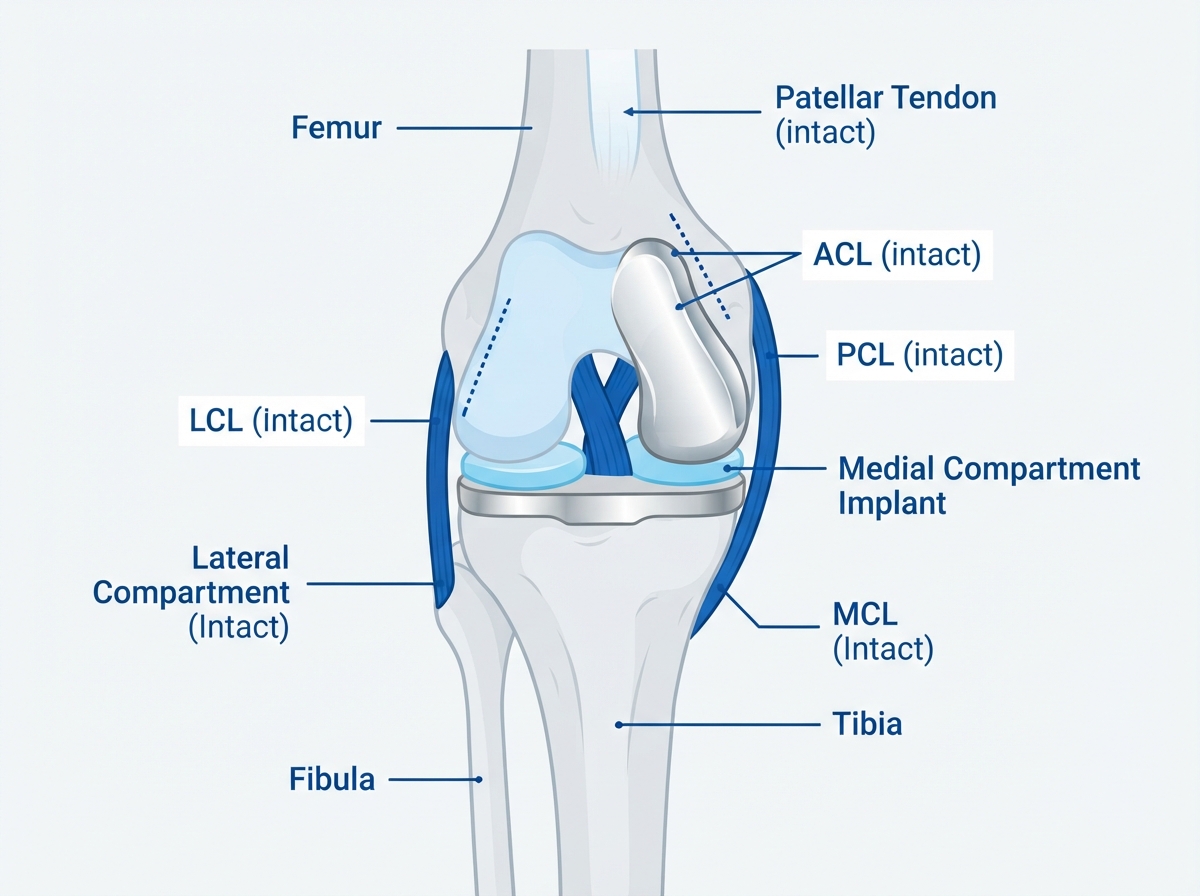
Partial Knee Replacement — illustrated overview of the surgical approach and implant placement.
What Makes This Approach Different
ACL & PCL Preservation
Unlike , preserves both cruciate ligaments, maintaining the knee's natural biomechanics and stability.
Smaller Incision
The incision is typically half the length of a total knee incision, resulting in less tissue trauma, less blood loss, and a smaller scar.
Faster Recovery
Most partial knee patients walk unassisted within 1-2 weeks and return to golf, tennis, and other activities in 6-10 weeks—roughly half the time of total knee recovery.
Convertible to Total Knee
If arthritis progresses in other compartments, a partial knee can be revised to a total knee. Because bone is preserved, this revision is typically simpler than revising a total knee.
Clinical information reviewed and edited by Dr. Ali H. Sobh, MD, board-certified orthopedic surgeon. Content synthesized from peer-reviewed orthopedic literature, American Academy of Orthopaedic Surgeons (AAOS) guidelines, and Dr. Sobh's fellowship training at Rush University Medical Center. Last updated 2025.
Interactive Education
See How Your Joint Works
Understanding your condition is the first step toward confident decisions. Use this interactive visualizer to explore the anatomy of the knee joint, compare a healthy joint with an arthritic one, and see exactly what partial knee replacement restores.
- 1Toggle states to compare healthy, arthritic, and post-surgical joints.
- 2Tap the dots to learn about each anatomical structure.
- 3Watch the motion to see how the joint moves during activity.
Interactive Joint Visualizer
Explore how partial knee replacement works
Recognizing the Signs
Common Symptoms
Many patients live with joint pain for years before seeking treatment. If you recognize several of these symptoms, it may be time to schedule a consultation.
When to seek care
Why Dr. Sobh for This Procedure
Fellowship-Trained Expertise in Partial Knee Replacement
Dr. Sobh combines his MAKO robotic training with partial knee expertise to precisely resurface only the damaged compartment. Because he uses robotic guidance, the bone cuts are extremely accurate and conservative—preserving healthy bone and your crucial ACL and PCL ligaments. His fellowship training emphasized patient selection: he carefully evaluates imaging to confirm arthritis is truly confined to one compartment, ensuring partial replacement will deliver long-lasting relief rather than masking progression in other areas.
Conditions Treated
Is Partial Knee Replacement Right for You?
Dr. Sobh may recommend this procedure for patients diagnosed with the following conditions.
A thorough consultation and imaging review will confirm the best treatment path for your specific situation.
Are You a Candidate?
Candidacy for Partial Knee Replacement
Dr. Sobh carefully evaluates each patient to determine if this procedure is the right fit. Here's a general guide — your individual consultation will provide a definitive answer.
Patients with arthritis confined to a single compartment (medial, lateral, or patellofemoral) confirmed on weight-bearing X-rays and MRI, with intact ACL and correctable deformity.
Active patients who want to preserve their ACL and return to sports or kneeling activities that total knee replacement may limit.
Patients with arthritis in two or more compartments, a deficient ACL, severe fixed deformity (>15°), or inflammatory arthritis (rheumatoid) are not candidates for partial knee replacement.
Patients with morbid obesity (BMI >40) may have higher failure rates with partial knee replacement due to increased load on the implant.
Technology & Techniques
Advanced Technology Used in Your Surgery
Dr. Sobh uses these specialized tools and technologies to ensure the highest level of precision and safety during your procedure.
MAKO Robotic Planning
A CT scan creates a 3D model of your knee. Dr. Sobh plans the exact bone cuts for the damaged compartment only, preserving healthy bone and ligaments.
Unicompartmental Implant
A metal femoral component and metal tibial baseplate with a polyethylene insert replace only the damaged compartment's bearing surfaces.
Ligament-Balancing Assessment
The robotic system allows Dr. Sobh to assess ligament tension through the full range of motion, ensuring the partial implant moves naturally with your preserved ligaments.
How the Surgery Works
Understanding Your Surgical Journey
From your first consultation to full recovery, here's what to expect at each stage. Dr. Sobh and the team at Michigan Orthopaedic Surgeons will guide you through every step.
MAKO Robotic Planning
A creates a 3D model of your knee. Dr. Sobh plans the exact bone cuts and position for the damaged compartment only, preserving healthy bone and ligaments.
Targeted Resurfacing
Only the arthritic portion of the knee is resurfaced with a metal and plastic . Your ACL, PCL, and healthy cartilage in other compartments remain intact.
Outpatient Recovery
Because the procedure is less invasive than , many patients qualify for outpatient surgery and return home the same day.
Recovery Timeline
Your Path Back to Activity
Recovery timelines vary by individual and procedure complexity. Dr. Sobh will provide a personalized rehabilitation plan. Here's a general guide to what most patients experience.
Day of Surgery
Walk with assistance. Many patients go home the same day. Begin gentle range-of-motion exercises.
Early Recovery
Walk with minimal support. Physical therapy focuses on knee bend and quadriceps activation. Less pain than total knee replacement.
Progressive Activity
Return to driving and work. Resume walking, stationary bike, and swimming. Therapy advances to strengthening.
Full Recovery
Return to golf, tennis, and recreational sports. The preserved ligaments provide a more natural-feeling knee than total replacement.
Comparing Your Options
Partial Knee Replacement vs. Alternatives
Understanding how partial knee replacement compares to other treatment options helps you make an informed decision. Dr. Sobh will discuss all viable options during your consultation.
Total Knee Replacement
Total knee replaces all three compartments and removes the ACL (and usually the PCL). It's necessary when arthritis affects multiple compartments but results in a less natural-feeling knee and longer recovery.
Knee Arthroscopy
Arthroscopy can clean up torn or cartilage flaps but cannot reverse arthritis. It may temporarily help but does not resurface the damaged joint surface like does.
High Tibial Osteotomy (HTO)
HTO realigns the leg by cutting and repositioning the to shift weight away from the arthritic compartment. It's an option for younger, active patients but has a longer recovery and doesn't resurface the damaged cartilage.
Patient Journey Tip
Benefits
This procedure offers significant advantages for qualified patients:
- Preserves healthy bone, cartilage, and ligaments (ACL/PCL)
- Smaller incision and less tissue damage
- Faster recovery than total knee replacement
- More natural knee bending and stability
- Often performed as outpatient surgery
- Easier to revise in the future if needed
Potential Risks
As with any surgery, there are potential risks. Dr. Sobh takes extensive measures to minimize them:
- Progression of arthritis in other compartments
- Implant loosening over time
- Infection (rare)
- Blood clots—prevented with medication and early walking
- Persistent pain if arthritis progresses
- Anesthesia-related risks
Important
Patient Questions
Frequently Asked Questions
Common questions patients ask about partial knee replacement.
Am I a candidate for partial knee replacement?
Am I a candidate for partial knee replacement?
You are a good candidate if your arthritis is confined to one compartment of your knee and your ligaments (especially the ACL) are intact. Dr. Sobh will use X-rays and MRI to confirm this during your consultation.
How is partial knee replacement different from total knee replacement?
How is partial knee replacement different from total knee replacement?
resurfaces only the damaged compartment, preserving healthy bone and ligaments. This results in a more natural-feeling knee, faster recovery, and smaller incision. resurfaces the entire joint.
Will I need a total knee replacement later?
Will I need a total knee replacement later?
Not necessarily. If arthritis progresses in the other compartments, a partial knee can be converted to a . Because partial replacement preserves bone, this conversion is typically straightforward.
How long does a partial knee implant last?
How long does a partial knee implant last?
Partial knee implants can last 15-20 years or more, depending on activity level, weight, and positioning. Dr. Sobh's MAKO robotic precision helps maximize longevity.
This procedure page was clinically reviewed and approved by Dr. Ali H. Sobh, MD, a board-certified, fellowship-trained orthopedic surgeon specializing in direct anterior hip replacement and MAKO robotic knee surgery. Dr. Sobh graduated with high honors from Wayne State University School of Medicine and completed his adult reconstruction fellowship at Rush University Medical Center in Chicago. He practices at Michigan Orthopaedic Surgeons (MOS) with offices in Royal Oak and Southfield, Michigan.
This information is for educational purposes only and is not a substitute for professional medical advice. Individual results and recovery timelines vary. Schedule a consultation with Dr. Sobh to discuss your specific condition and treatment options.

Ready to Take the Next Step?
Schedule a personalized consultation with Dr. Sobh to discuss whether partial knee replacement is right for you. Our team will help coordinate your visit, insurance verification, and pre-operative planning.
Explore More
Related Procedures
MAKO Robotic Joint Replacement
Cutting-edge robotic-arm assisted surgery providing personalized 3D surgical plans.
Total Knee Replacement
Advanced total knee reconstruction for severe, end-stage arthritis and joint degradation.
Revision Knee Replacement
Subspecialized evaluation and surgical correction for previously failed knee replacements.
Helpful Patient Resources