
Total Knee Replacement
Total knee replacement replaces damaged cartilage and bone surfaces with premium biocompatible implants. Combined with Dr. Sobh's advanced pain management and rapid-recovery protocols, total knee arthroplasty restores joint function and eliminates chronic knee pain.

Understanding Your Procedure
In-Depth: Total Knee Replacement
A clear, comprehensive look at what this procedure is, how it works, and why it may be the right choice for you.
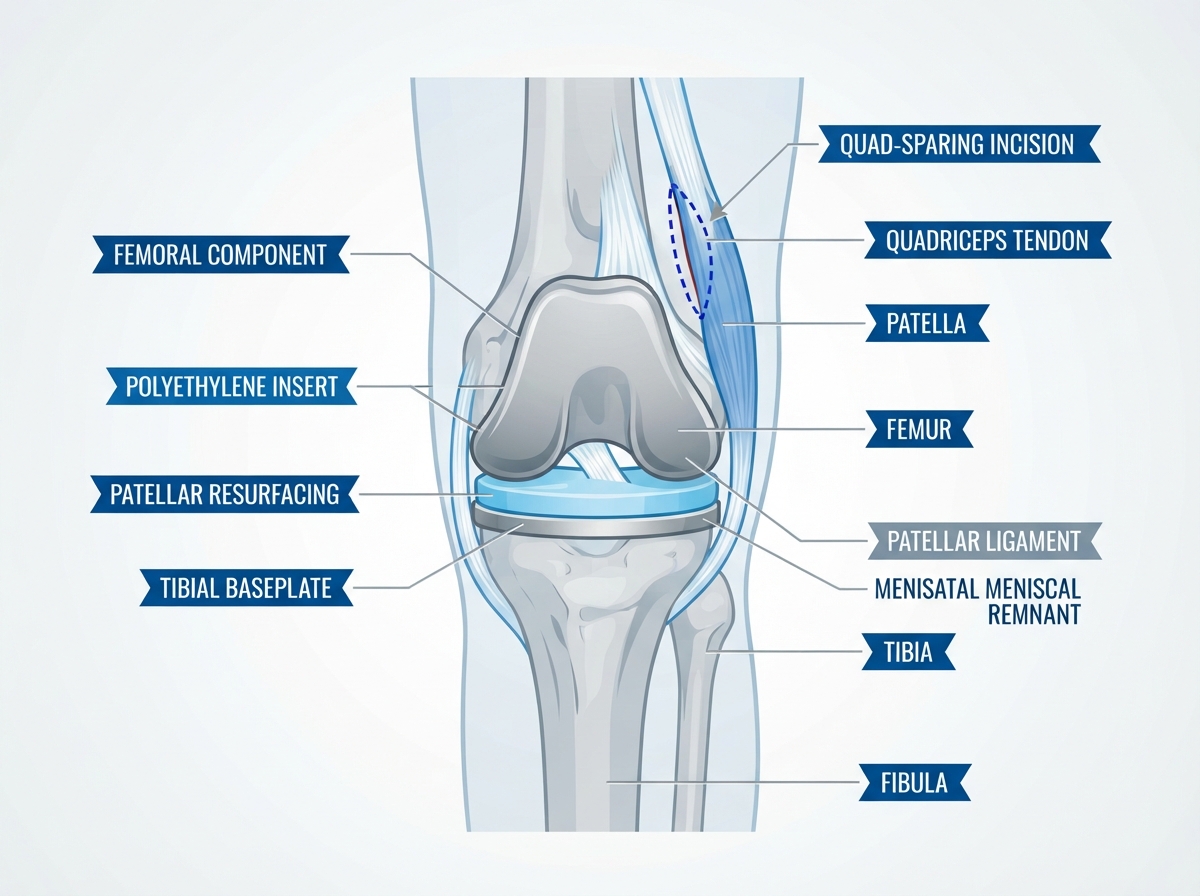
Total Knee Replacement — illustrated overview of the surgical approach and implant placement.
What Makes This Approach Different
Quad-Sparing Technique
The is not cut, preserving the thigh muscle's function and dramatically reducing pain and recovery time compared to traditional approaches.
Multimodal Pain Protocol
A combination of nerve blocks, long-acting local anesthetics, and non-opioid medications keeps patients comfortable while minimizing or eliminating the need for opioids.
Mechanical Axis Alignment
Dr. Sobh restores your leg's mechanical axis—the line of weight-bearing from hip to ankle—correcting bowing or knock-knee deformity that has developed from arthritis.
Premium Implant Selection
Modern implants with improved bearing surfaces and design allow for natural knee kinematics, including deep knee bend and 'female-friendly' designs that accommodate narrower femurs.
Clinical information reviewed and edited by Dr. Ali H. Sobh, MD, board-certified orthopedic surgeon. Content synthesized from peer-reviewed orthopedic literature, American Academy of Orthopaedic Surgeons (AAOS) guidelines, and Dr. Sobh's fellowship training at Rush University Medical Center. Last updated 2025.
Watch & Learn
Understanding Total Knee Replacement
These medically accurate 3D animations walk you through the surgical procedure step by step — from incision to implant placement — so you know exactly what happens during your surgery.
Total Knee Replacement Surgery
A concise 3D medical animation from Nucleus Health showing each surgical step: incision, exposure of the arthritic joint, removal of damaged bone, placement of the femoral and tibial prostheses, and closure.
Complete Surgical Procedure Animation
An in-depth 3D animation covering preoperative preparation, detailed surgical steps from incision to implantation, and postoperative care insights including physical therapy and rehabilitation tips.
How Dr. Sobh's approach may differ
Videos embedded from YouTube for educational purposes. Dr. Dr. Ali H. Sobh, MD reviews all educational content on this page. Animation sources: Nucleus Medical Media and Understand (medical education). Procedure techniques may vary based on surgeon preference and patient anatomy.
Interactive Education
See How Your Joint Works
Understanding your condition is the first step toward confident decisions. Use this interactive visualizer to explore the anatomy of the knee joint, compare a healthy joint with an arthritic one, and see exactly what total knee replacement restores.
- 1Toggle states to compare healthy, arthritic, and post-surgical joints.
- 2Tap the dots to learn about each anatomical structure.
- 3Watch the motion to see how the joint moves during activity.
Interactive Joint Visualizer
Explore how total knee replacement works
Recognizing the Signs
Common Symptoms
Many patients live with joint pain for years before seeking treatment. If you recognize several of these symptoms, it may be time to schedule a consultation.
When to seek care
Why Dr. Sobh for This Procedure
Fellowship-Trained Expertise in Total Knee Replacement
Dr. Sobh uses a quad-sparing, minimally invasive approach to that protects the thigh muscle during surgery—reducing pain and accelerating recovery. His Rush University fellowship focused on advanced alignment and balancing techniques that ensure the moves naturally with your ligaments. He pairs this with a multimodal pain management protocol (nerve blocks, long-acting anesthetics, and non-opioid medications) so most patients walk within hours of surgery and use minimal or no opioids.
Conditions Treated
Is Total Knee Replacement Right for You?
Dr. Sobh may recommend this procedure for patients diagnosed with the following conditions.
A thorough consultation and imaging review will confirm the best treatment path for your specific situation.
Are You a Candidate?
Candidacy for Total Knee Replacement
Dr. Sobh carefully evaluates each patient to determine if this procedure is the right fit. Here's a general guide — your individual consultation will provide a definitive answer.
Patients with severe osteoarthritis in two or more knee compartments whose pain has not responded to at least 3-6 months of conservative treatment (PT, injections, NSAIDs, weight management).
Patients with significant knee deformity (bowing or knock-knee), instability, or loss of range of motion that limits daily activities.
Patients with arthritis in only one compartment and an intact ACL may be better served by partial knee replacement, which preserves more native anatomy.
Patients with active knee infection, severe vascular disease, or medical conditions that cannot be optimized for surgery need to address those issues first.
Technology & Techniques
Advanced Technology Used in Your Surgery
Dr. Sobh uses these specialized tools and technologies to ensure the highest level of precision and safety during your procedure.
Quad-Sparing Minimally Invasive Approach
A smaller incision and muscle-sparing technique that protects the quadriceps mechanism, reducing pain and accelerating rehabilitation.
Advanced Pain Management Protocol
Pre-operative medications, intra-operative nerve blocks (adductor canal block), and long-acting local anesthetics (Exparel) work together to minimize pain and opioid use.
Computer-Assisted Alignment
Dr. Sobh may use MAKO robotic assistance or computer navigation to ensure the implant is aligned to your unique mechanical axis, optimizing longevity and function.
Premium Implant Bearings
Modern cobalt-chromium and oxidized zirconium femoral components with highly cross-linked polyethylene inserts offer excellent wear resistance and 20+ year longevity.
How the Surgery Works
Understanding Your Surgical Journey
From your first consultation to full recovery, here's what to expect at each stage. Dr. Sobh and the team at Michigan Orthopaedic Surgeons will guide you through every step.
Surgical Planning
size and alignment are planned based on your anatomy. Dr. Sobh uses a quad-sparing, minimally invasive approach to protect your thigh muscle during surgery.
Joint Resurfacing
Damaged cartilage and bone are removed from the , , and . Premium metal and plastic components are cemented in place to recreate a smooth, pain-free joint surface.
Advanced Pain Management
Dr. Sobh uses a multimodal pain protocol—including nerve blocks, long-acting local anesthetics, and non-opioid medications—to keep you comfortable and minimize narcotic use.
Rapid Recovery Protocol
begins the day of surgery. Most patients walk with assistance within hours and are discharged home within 24-48 hours with a structured therapy plan.
Recovery Timeline
Your Path Back to Activity
Recovery timelines vary by individual and procedure complexity. Dr. Sobh will provide a personalized rehabilitation plan. Here's a general guide to what most patients experience.
Day of Surgery
Stand and walk with a walker. Begin knee bending exercises. Pain managed with Dr. Sobh's multimodal protocol.
Early Recovery
Walk with a walker or cane. Physical therapy focuses on knee bend (goal: 90°) and quadriceps strength. Incision heals.
Strengthening Phase
Transition off walking aids. Resume driving and office work. Therapy advances to strengthening, balance, and endurance.
Full Recovery
Return to walking, golf, swimming, and low-impact activities. Substantial motion and strength restored. Tissue remodeling continues for up to a year.
Comparing Your Options
Total Knee Replacement vs. Alternatives
Understanding how total knee replacement compares to other treatment options helps you make an informed decision. Dr. Sobh will discuss all viable options during your consultation.
Partial Knee Replacement
Partial knee replaces only one compartment and preserves the ACL/PCL. It's an option when arthritis is confined to one compartment, but not suitable when multiple compartments are damaged.
Corticosteroid Injections
Injections can temporarily reduce inflammation but do not reverse arthritis. They may provide weeks to months of relief but eventually lose effectiveness as the arthritis progresses.
Physical Therapy & Bracing
Conservative treatment can strengthen muscles and improve mechanics but cannot restore the lost cartilage. It's appropriate for early arthritis but insufficient for end-stage disease where bone rubs on bone.
Patient Journey Tip
Benefits
This procedure offers significant advantages for qualified patients:
- Eliminates bone-on-bone knee pain
- Restores knee alignment and corrects bowing
- Improves walking distance and quality of life
- Quad-sparing minimally invasive technique
- Advanced pain management reduces opioid use
- Durable implants lasting 20+ years
Potential Risks
As with any surgery, there are potential risks. Dr. Sobh takes extensive measures to minimize them:
- Infection (rare, <1%)
- Blood clots—prevented with medication and early walking
- Stiffness or arthrofibrosis (managed with therapy)
- Implant loosening or wear over decades
- Nerve or blood vessel injury (very rare)
- Anesthesia-related risks
Important
Patient Questions
Frequently Asked Questions
Common questions patients ask about total knee replacement.
How long does a total knee replacement last?
How long does a total knee replacement last?
Modern total knee implants are designed to last 20-30 years or more. Dr. Sobh uses premium bearing surfaces and precise alignment to maximize longevity. Factors like weight, activity level, and positioning affect lifespan.
Will I need opioids after surgery?
Will I need opioids after surgery?
Dr. Sobh uses an advanced multimodal pain protocol that combines nerve blocks, long-acting local anesthetics, and non-opioid medications. Most patients use minimal or no opioids and transition to over-the-counter pain relievers within 1-2 weeks.
When can I drive after total knee replacement?
When can I drive after total knee replacement?
Most patients can drive 2-4 weeks after surgery, once they have stopped taking opioid medications and can safely operate the pedals. If the left knee is operated on and you drive an automatic, you may drive sooner.
What activities should I avoid after total knee replacement?
What activities should I avoid after total knee replacement?
You should avoid high-impact activities like running, jumping, and singles tennis long-term. Walking, golf, swimming, cycling, doubles tennis, and other low-impact activities are encouraged and enjoyable with your new knee.
This procedure page was clinically reviewed and approved by Dr. Ali H. Sobh, MD, a board-certified, fellowship-trained orthopedic surgeon specializing in direct anterior hip replacement and MAKO robotic knee surgery. Dr. Sobh graduated with high honors from Wayne State University School of Medicine and completed his adult reconstruction fellowship at Rush University Medical Center in Chicago. He practices at Michigan Orthopaedic Surgeons (MOS) with offices in Royal Oak and Southfield, Michigan.
This information is for educational purposes only and is not a substitute for professional medical advice. Individual results and recovery timelines vary. Schedule a consultation with Dr. Sobh to discuss your specific condition and treatment options.

Ready to Take the Next Step?
Schedule a personalized consultation with Dr. Sobh to discuss whether total knee replacement is right for you. Our team will help coordinate your visit, insurance verification, and pre-operative planning.
Explore More
Related Procedures
MAKO Robotic Joint Replacement
Cutting-edge robotic-arm assisted surgery providing personalized 3D surgical plans.
Partial Knee Replacement
Targeted resurfacing of damaged knee compartments while preserving healthy bone and ligaments.
Revision Knee Replacement
Subspecialized evaluation and surgical correction for previously failed knee replacements.
Helpful Patient Resources